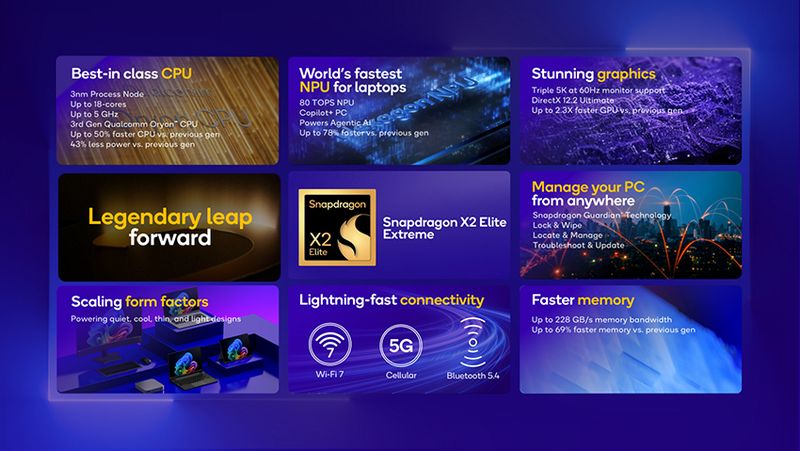

seniorspectrumnewspaper – Qualcomm has unveiled the Snapdragon X2 Elite Extreme and X2 Elite SoCs, pushing the boundaries of laptop performance. At the heart of this innovation is the new Hexagon NPU 6, which promises unprecedented AI capabilities. With an impressive 80 TOPS (Tera Operations Per Second) of AI processing power, the Hexagon NPU 6 is positioned as the fastest laptop NPU available. Far outpacing competitors like the Apple M4, Intel Core Ultra 9 288V, and AMD Ryzen AI 9 HX 370.
Read More : Amazon Alexa+ Launches in Canada with New Features
The Hexagon NPU 6’s performance is a significant leap from its predecessor, which offered 45 TOPS of AI power. Qualcomm highlights that this increase—nearly 78%—enables next-gen applications and workflows. The enhanced NPU is specifically designed to handle the growing demand for more complex AI tasks. Such as agentic AI workloads and large language model (LLM) processing. Qualcomm demonstrates that a single LLM with 14 billion parameters requires up to 143 TOPS of AI processing power. Making the NPU 6 capable of supporting even the most demanding tasks in laptop environments.
The Snapdragon X2 Elite Extreme SoC integrates these advanced AI capabilities with improved CPU, GPU, and memory performance. Together, they offer an all-around performance boost, especially for power-hungry tasks like AI inferencing. This integration leverages Qualcomm’s deep collaboration with Windows AI software and supports popular open-source machine learning frameworks. Including TensorFlow and PyTorch. With the ONNX Runtime provided by Windows ML, Qualcomm aims to make on-device AI processing faster and more efficient.
Key Features of Qualcomm’s Hexagon NPU 6: Power and Efficiency
The Snapdragon X2 Elite Extreme SoC’s Hexagon NPU 6 brings several architectural enhancements over previous versions. One of the most notable improvements is the significant increase in performance per watt and lower latency. Qualcomm’s new NPU offers up to 1.6x more performance than the one found in the Snapdragon X Elite. While maintaining the same 5W power consumption during an Enhanced Deep Super-Resolution (EDSR) workflow. This boost allows for faster processing without compromising battery life or power efficiency.
The Hexagon NPU 6 also introduces faster scalar and vector processing. Qualcomm has evolved Hexagon from its original digital signal processing roots to its current NPU form. Which can handle scalar, vector, integer, and matrix operations. The latest version supports 12 threads for scalar processing, achieving a 143% increase in throughput with reduced latency. Additionally, the NPU features a 127% faster bus and can process vector workloads up to 143% faster with support for FP8 and BF16.
Another key feature of the NPU 6 is the matrix unit, which now has an independent power rail and is up to 78% faster. This unit supports 2-bit weight and FP8+BF16 operations, further optimizing AI workloads. Qualcomm also claims that the Hexagon NPU 6 is capable of delivering up to 5.7x the performance and 3.8x the efficiency compared to the Intel Core Ultra 9 285H NPU in Procyon AI Computer Vision tests.
Read More : Qualcomm Claims Elite X2 Graphics 50% Faster Than Intel
These advancements allow the Snapdragon X2 Elite Extreme to offer superior AI performance in various applications, such as Adobe Premiere, Blender, Affinity Photo, and more. The chip’s performance benchmarks, like those seen in Geekbench AI, show that the NPU 6 outperforms its rivals, being nearly 70% faster than the Apple M4 and 82.4% faster than the Intel Core Ultra 9 288V.
Looking ahead, Qualcomm’s innovative Hexagon NPU 6 positions the Snapdragon X2 Elite Extreme as a leading choice for laptops that require high-performance AI processing. With more devices launching early next year, it will be exciting to see how this new SoC transforms the laptop market.